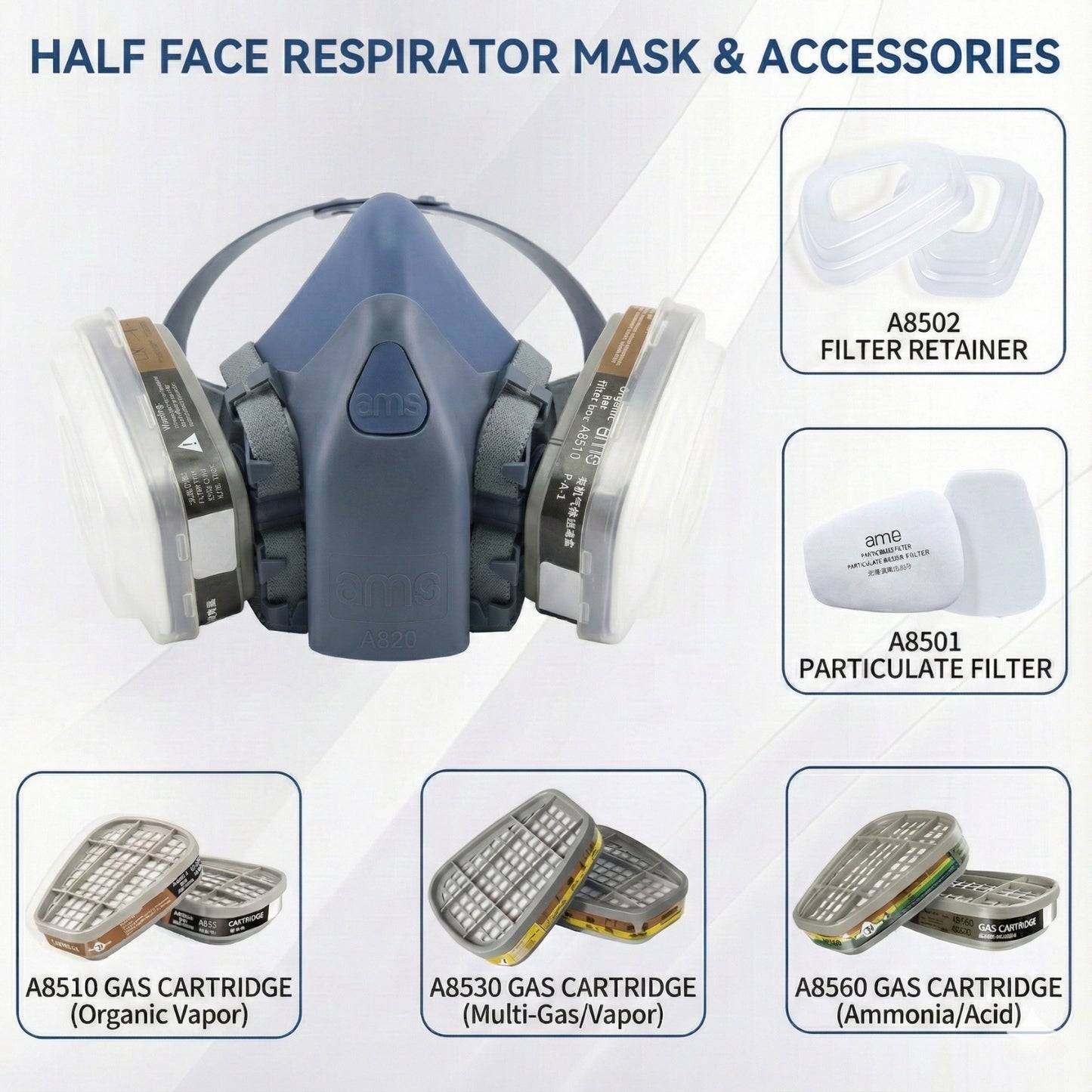
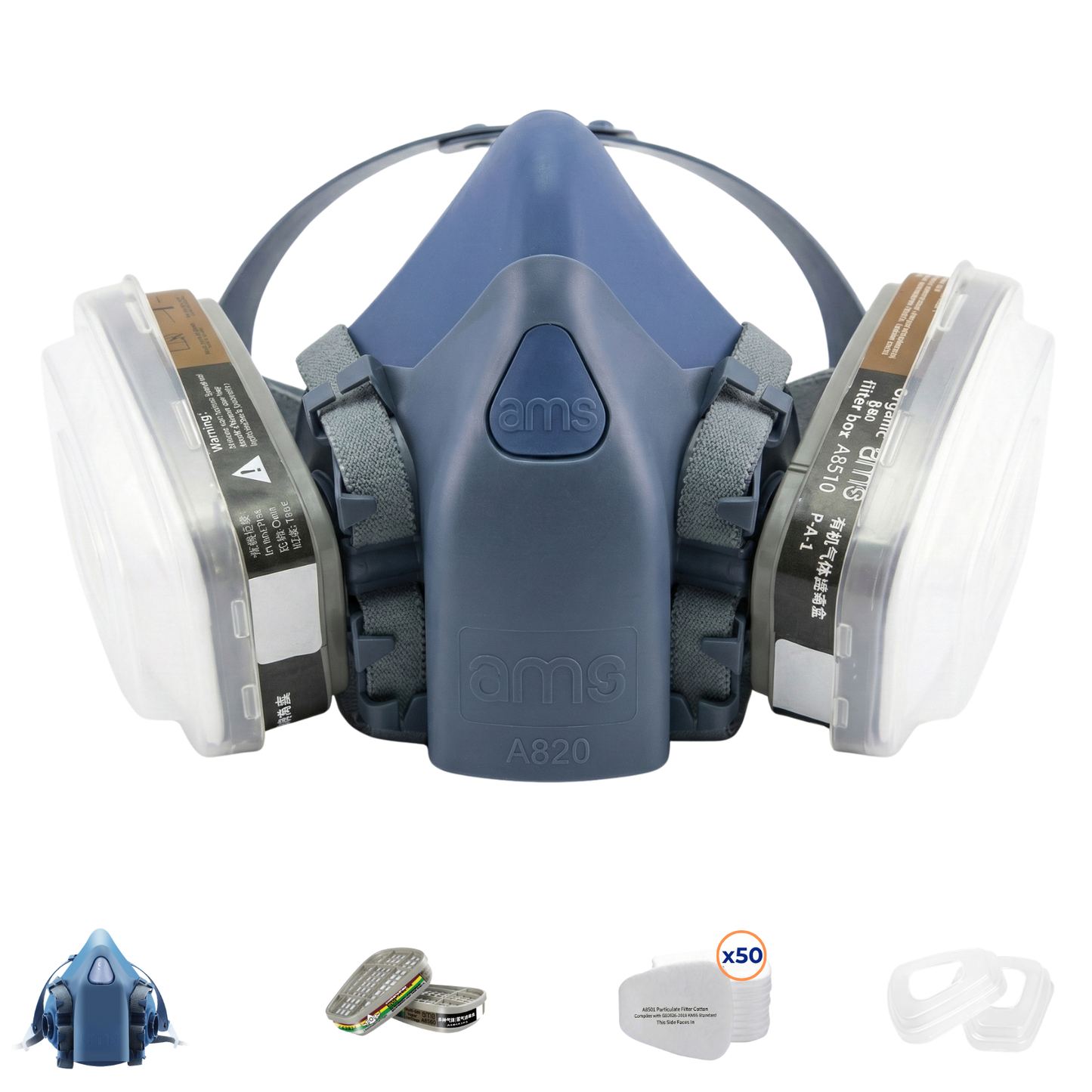
You bought the best filters. You bought a professional-grade mask. But ask yourself this: Is it actually sealing?
In the world of respiratory protection, there is a concept called "The Path of Least Resistance." Air works like water—it will always flow through the easiest opening. If your mask has even a microscopic gap between the silicone and your skin, toxic fumes will bypass your expensive filters and go straight into your lungs. Today, we discuss the science of the "Perfect Seal" and why the material of your mask matters just as much as the size.
The 2-Minute Safety Ritual: How to Check Your Seal
Every time you put on your AMS Respirator, before you enter the hazardous zone, you must perform these two simple checks. OSHA mandates this for professionals, and you should do it too.
1. The Positive Pressure Check (Exhalation)
- Put the mask on and adjust the straps comfortably.
- Place the palm of your hand over the exhaust valve cover (the center piece pointing down).
- Exhale gently.
- Result: The facepiece should bulge slightly outward. If you feel air escaping near your eyes or chin, the seal is bad. Adjust the straps and try again.
2. The Negative Pressure Check (Inhalation)
- Place your palms over the two filter cartridges (or the intake ports if filters aren't attached yet) to block the airflow.
- Inhale gently and hold your breath for 5 seconds.
- Result: The facepiece should collapse slightly inward against your face and stay collapsed while you hold your breath. If the mask expands back to normal immediately, air is leaking in.
Why Do Seals Fail?
Most leaks happen for three reasons:
- Facial Hair: Stubble acts like a spacer, lifting the mask off the skin. You must be clean-shaven where the mask seals.
- Face Movement: When you talk, smile, or look down, your facial muscles change shape, creating gaps.
- Material Stiffness: This is the most overlooked factor. Standard rubber masks are stiff. If your face moves, the rubber doesn't move with it, breaking the seal.
The AMS-A820 Solution: Dynamic Sealing
This is where the AMS-A820 shines. Because it is made from Liquid Silicone Rubber (LSR), it possesses a property called "Dynamic Sealing."
Imagine the difference between a leather shoe and a spandex sock. A leather shoe is stiff; if you move your foot weirdly, gaps appear. A spandex sock moves with you.
The AMS-A820 acts like the sock. Its ultra-thin, feathered edges conform to the micro-movements of your face. Whether you are shouting to a coworker, sweating in the heat, or contorting your neck to weld a pipe, the Liquid Silicone flexes to maintain the vacuum seal.
Comparison: Leakage Risk
| Scenario | Standard Rubber Mask | AMS-A820 (Liquid Silicone) |
|---|---|---|
| Talking/Yelling | High Risk of Leakage | Secure Seal (Flexes with jaw) |
| Looking Down | Gap often forms at nose bridge | Maintains Contact |
| Sweating | Mask slides/shifts | High Friction Grip (Non-slip) |
FAQ: Fit & Sizing
Q: How tight should the straps be?
A: Tighter is NOT better. Overtightening distorts the silicone and creates gaps (and headaches!). The AMS-A820 is designed to seal with very light tension. Pull until it's just snug, then do the seal check.
Q: I wear glasses. Will this affect the seal?
A: The mask sits low on the nose, so it generally does not interfere with glasses. However, ensure the temples (arms) of your glasses go over the mask straps, not under the silicone seal.
Q: Does one size fit all?
A: The AMS-A820 is a "Medium/Universal" fit designed to cover 85-90% of adult face shapes. The flexibility of Liquid Silicone allows it to accommodate a wider range of face sizes than rigid rubber masks.
Safety is a System, Not Just a Product
The best filter in the world can't save you if the air goes around it. Invest in a mask that is engineered to stay sealed, no matter how hard you work.